Microsoft DP-300 Exam Engine | DP-300 Exam Voucher
Wiki Article
P.S. Free 2026 Microsoft DP-300 dumps are available on Google Drive shared by ActualTestsQuiz: https://drive.google.com/open?id=1IJWpN0D0cgumi-Z5CKmP1aKVsRmI1s-h
There is no shortcut to Microsoft DP-300 exam questions success except hard work. You cannot expect your dream of earning the Administering Relational Databases on Microsoft Azure CERTIFICATION EXAM come true without using updated study material Administering Relational Databases on Microsoft Azure (DP-300) exam questions. Success in the DP-300 exam adds more value to your resume and helps you land the best jobs in the industry.
As is known to all, before purchasing the DP-300 Study Guide, we need to know the features of it. We offer you free demo to have a try, so that you can know the characteristics of DP-300 exam dumps. Beside we have three versions, each version have its own advantages, and they can meet all of your demands. And we have free update for 365 days after buying, the latest version will send to you email box automatically.
>> Microsoft DP-300 Exam Engine <<
DP-300 Exam Voucher & Prep DP-300 Guide
Our exam dumps are created by our professional IT trainers who are specialized in the Microsoft real dumps for many years and they know the key points of test well. So we can ensure you the accuracy and valid of DP-300 dump pdf. Before you buy, you can download the free trial of DP-300 Exam Cram. If you have any problems in the course of purchasing or downloading the DP-300 certification dumps you can contact us anytime.
Microsoft DP-300 (Administering Relational Databases on Microsoft Azure) Certification Exam is designed for individuals who are responsible for managing and administering relational databases on Microsoft Azure. Administering Relational Databases on Microsoft Azure certification validates the skills and knowledge required to work with Azure SQL databases, including provisioning, securing, monitoring, and optimizing performance.
Microsoft Administering Relational Databases on Microsoft Azure Sample Questions (Q29-Q34):
NEW QUESTION # 29
You have an Azure virtual machine named VM1 on a virtual network named VNet1. Outbound traffic from VM1 to the internet is blocked.
You have an Azure SQL database named SqlDb1 on a logical server named SqlSrv1.
You need to implement connectivity between VM1 and SqlDb1 to meet the following requirements:
* Ensure that VM1 cannot connect to any Azure SQL Server other than SqlSrv1.
* Restrict network connectivity to SqlSrv1.
What should you create on VNet1?
- A. a VPN gateway
- B. a private endpoint
- C. a service endpoint
- D. an ExpressRoute gateway
Answer: B
Explanation:
Explanation
A private endpoint is a network interface that uses a private IP address from your virtual network. This network interface connects you privately and securely to a service powered by Azure Private Link. By enabling a private endpoint, you're bringing the service into your virtual network.
The service could be an Azure service such as:
* Azure Storage
* Azure Cosmos DB
* Azure SQL Database
* Your own service using a Private Link Service.
Reference:
https://docs.microsoft.com/en-us/azure/private-link/private-endpoint-overview
NEW QUESTION # 30
You need to recommend an availability strategy for an Azure SQL database. The strategy must meet the following requirements:
Support failovers that do not require client applications to change their connection strings.
Replicate the database to a secondary Azure region.
Support failover to the secondary region.
What should you include in the recommendation?
- A. Availability Zones
- B. failover groups
- C. transactional replication
- D. geo-replication
Answer: D
Explanation:
Active geo-replication is an Azure SQL Database feature that allows you to create readable secondary databases of individual databases on a server in the same or different data center (region).
Incorrect Answers:
C: Availability Zones are unique physical locations within a region. Each zone is made up of one or more datacenters equipped with independent power, cooling, and networking.
Reference:
https://docs.microsoft.com/en-us/azure/azure-sql/database/active-geo-replication-overview
NEW QUESTION # 31
From a website analytics system, you receive data extracts about user interactions such as downloads, link clicks, form submissions, and video plays.
The data contains the following columns:
You need to design a star schema to support analytical queries of the dat a. The star schema will contain four tables including a date dimension.
To which table should you add each column? To answer, select the appropriate options in the answer area.
NOTE: Each correct selection is worth one point.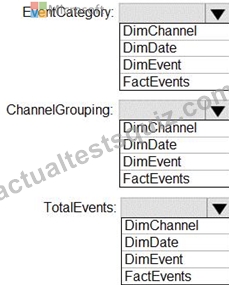
Answer:
Explanation: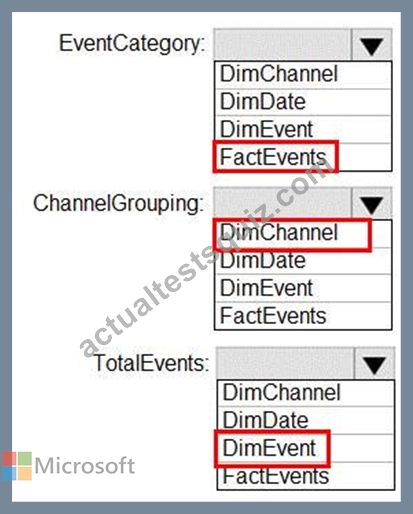
Reference:
https://docs.microsoft.com/en-us/power-bi/guidance/star-schema
NEW QUESTION # 32
You have a new Azure SQL database named DB1 on an Azure SQL server named AzSQL1.
The only user who was created is the server administrator.
You need to create a contained database user in DB1 who will use Azure Active Directory (Azure AD) for authentication.
Which three actions should you perform in sequence? To answer, move the appropriate actions from the list of actions to the answer area and arrange them in the correct order.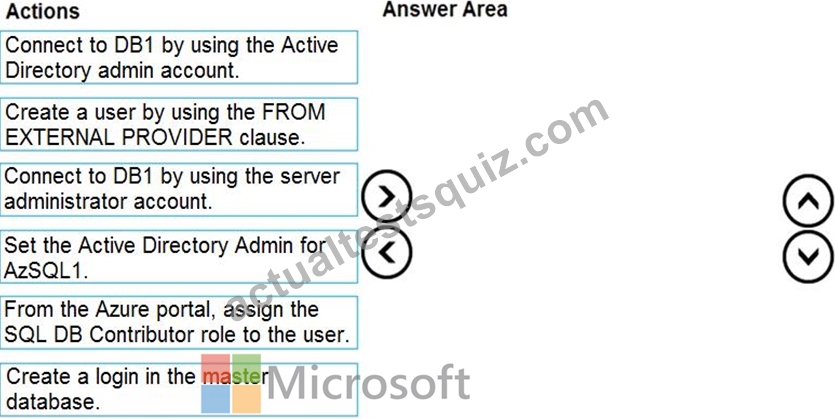
Answer:
Explanation: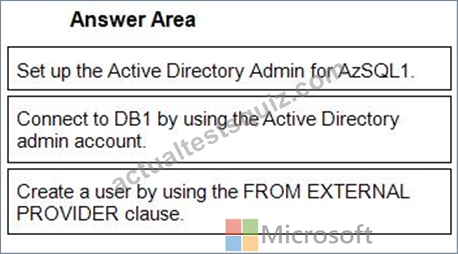
1 - Set up the Active Directory Admin for AzSQL1.
2 - Connect to DB1 by using the Active Directory admin account.
3 - Create a user by using the FROM EXTERNAL PROVIDER clause.
Reference:
https://docs.microsoft.com/en-us/sql/t-sql/statements/create-user-transact-sql
NEW QUESTION # 33
You need to provide an implementation plan to configure data retention for ResearchDB1. The solution must meet the security and compliance requirements.
What should you include in the plan?
- A. Configure the Advanced Data Security settings for ResearchDBL
- B. Configure the Manage Backups settings for ResearchSrvOL
- C. Deploy and configure an Azure Backup server.
- D. Configure the Deleted databases settings for ResearchSrvOL
Answer: B
Explanation:
Reference:
https://docs.microsoft.com/en-us/azure/azure-sql/database/long-term-backup-retention-configure
This is a case study. Case studies are not timed separately. You can use as much exam time as you would like to complete each case. However, there may be additional case studies and sections on this exam. You must manage your time to ensure that you are able to complete all questions included on this exam in the time provided.
To answer the questions included in a case study, you will need to reference information that is provided in the case study. Case studies might contain exhibits and other resources that provide more information about the scenario that is described in the case study. Each question is independent of the other questions in this case study.
At the end of this case study, a review screen will appear. This screen allows you to review your answers and to make changes before you move to the next section of the exam. After you begin a new section, you cannot return to this section.
To start the case study
To display the first question in this case study, click the Next button. Use the buttons in the left pane to explore the content of the case study before you answer the questions. Clicking these buttons displays information such as business requirements, existing environment, and problem statements. If the case study has an All Information tab, note that the information displayed is identical to the information displayed on the subsequent tabs. When you are ready to answer a question, click the Question button to return to the question.
Overview
Topic 1, Litware
Existing Environment
Network Environment
The manufacturing and research datacenters connect to the primary datacenter by using a VPN.
The primary datacenter has an ExpressRoute connection that uses both Microsoft peering and private peering. The private peering connects to an Azure virtual network named HubVNet.
Identity Environment
Litware has a hybrid Azure Active Directory (Azure AD) deployment that uses a domain named litwareinc.com. All Azure subscriptions are associated to the litwareinc.com Azure AD tenant.
Database Environment
The sales department has the following database workload:
An on-premises named SERVER1 hosts an instance of Microsoft SQL Server 2012 and two 1-TB databases.
A logical server named SalesSrv01A contains a geo-replicated Azure SQL database named SalesSQLDb1. SalesSQLDb1 is in an elastic pool named SalesSQLDb1Pool. SalesSQLDb1 uses database firewall rules and contained database users.
An application named SalesSQLDb1App1 uses SalesSQLDb1.
The manufacturing office contains two on-premises SQL Server 2016 servers named SERVER2 and SERVER3. The servers are nodes in the same Always On availability group. The availability group contains a database named ManufacturingSQLDb1
Database administrators have two Azure virtual machines in HubVnet named VM1 and VM2 that run Windows Server 2019 and are used to manage all the Azure databases.
Licensing Agreement
Litware is a Microsoft Volume Licensing customer that has License Mobility through Software Assurance.
Current Problems
SalesSQLDb1 experiences performance issues that are likely due to out-of-date statistics and frequent blocking queries.
Requirements
Planned Changes
Litware plans to implement the following changes:
Implement 30 new databases in Azure, which will be used by time-sensitive manufacturing apps that have varying usage patterns. Each database will be approximately 20 GB.
Create a new Azure SQL database named ResearchDB1 on a logical server named ResearchSrv01. ResearchDB1 will contain Personally Identifiable Information (PII) data.
Develop an app named ResearchApp1 that will be used by the research department to populate and access ResearchDB1.
Migrate ManufacturingSQLDb1 to the Azure virtual machine platform.
Migrate the SERVER1 databases to the Azure SQL Database platform.
Technical Requirements
Litware identifies the following technical requirements:
Maintenance tasks must be automated.
The 30 new databases must scale automatically.
The use of an on-premises infrastructure must be minimized.
Azure Hybrid Use Benefits must be leveraged for Azure SQL Database deployments.
All SQL Server and Azure SQL Database metrics related to CPU and storage usage and limits must be analyzed by using Azure built-in functionality.
Security and Compliance Requirements
Litware identifies the following security and compliance requirements:
Store encryption keys in Azure Key Vault.
Retain backups of the PII data for two months.
Encrypt the PII data at rest, in transit, and in use.
Use the principle of least privilege whenever possible.
Authenticate database users by using Active Directory credentials.
Protect Azure SQL Database instances by using database-level firewall rules.
Ensure that all databases hosted in Azure are accessible from VM1 and VM2 without relying on public endpoints.
Business Requirements
Litware identifies the following business requirements:
Meet an SLA of 99.99% availability for all Azure deployments.
Minimize downtime during the migration of the SERVER1 databases.
Use the Azure Hybrid Use Benefits when migrating workloads to Azure.
Once all requirements are met, minimize costs whenever possible.
NEW QUESTION # 34
......
Maybe there are so many candidates think the DP-300 exam is difficult to pass that they be beaten by it. But now, you don’t worry about that anymore, because we will provide you an excellent exam material. Our DP-300 exam materials are very useful for you and can help you score a high mark in the test. It also boosts the function of timing and the function to simulate the DP-300 Exam so you can improve your speed to answer and get full preparation for the test. Trust us that our DP-300 exam torrent can help you pass the exam and find an ideal job.
DP-300 Exam Voucher: https://www.actualtestsquiz.com/DP-300-test-torrent.html
- DP-300 Practice Guide ???? Reliable DP-300 Test Labs ⬅️ DP-300 Latest Exam Testking ???? Search for 《 DP-300 》 and obtain a free download on 《 www.practicevce.com 》 ????Customized DP-300 Lab Simulation
- [2026] Updated Microsoft DP-300 Dumps - Tips For Better Preparation ⏲ Copy URL ⏩ www.pdfvce.com ⏪ open and search for 【 DP-300 】 to download for free ????Authorized DP-300 Test Dumps
- [2026] Updated Microsoft DP-300 Dumps - Tips For Better Preparation ???? Download ( DP-300 ) for free by simply entering [ www.vce4dumps.com ] website ????DP-300 Reliable Exam Guide
- DP-300 Instant Access ???? DP-300 Latest Exam Testking ???? Latest DP-300 Test Testking ???? Simply search for “ DP-300 ” for free download on ➠ www.pdfvce.com ???? ????DP-300 Real Dump
- Free PDF Quiz Updated DP-300 - Administering Relational Databases on Microsoft Azure Exam Engine ???? Open website ( www.troytecdumps.com ) and search for 【 DP-300 】 for free download ????DP-300 Practical Information
- DP-300 Exam Engine Will Be Your Best Friend to Pass Administering Relational Databases on Microsoft Azure ???? Easily obtain free download of 【 DP-300 】 by searching on ➤ www.pdfvce.com ⮘ ????New DP-300 Exam Format
- Latest DP-300 Exam Labs ⛑ Reliable DP-300 Test Labs ☎ DP-300 Latest Study Plan ???? Download 《 DP-300 》 for free by simply entering ➽ www.exam4labs.com ???? website ????Reliable DP-300 Learning Materials
- Useful DP-300 Exam Engine for Real Exam ???? 「 www.pdfvce.com 」 is best website to obtain 【 DP-300 】 for free download ????Valid DP-300 Test Online
- DP-300 Exam Engine Will Be Your Best Friend to Pass Administering Relational Databases on Microsoft Azure ???? Search on ⮆ www.testkingpass.com ⮄ for ▷ DP-300 ◁ to obtain exam materials for free download ????Authorized DP-300 Test Dumps
- DP-300 Exam Engine - Microsoft Administering Relational Databases on Microsoft Azure Realistic Exam Engine Pass Guaranteed ???? Search for ✔ DP-300 ️✔️ and obtain a free download on ➡ www.pdfvce.com ️⬅️ ????Latest DP-300 Exam Labs
- DP-300 Exam Engine - Microsoft Administering Relational Databases on Microsoft Azure Realistic Exam Engine Pass Guaranteed ???? Easily obtain ▛ DP-300 ▟ for free download through ( www.easy4engine.com ) ????New DP-300 Exam Format
- helpingmummiesanddaddiesagencytt.com, bookmarkswing.com, abeluxmn257945.ttblogs.com, andrewaobb610260.theobloggers.com, hocnhanh.online, rishivdjy781261.blog-mall.com, courses.nikhilashtewale.com, roxanneidt920675.gynoblog.com, amaandrvp815719.p2blogs.com, nevekpig687890.blogrelation.com, Disposable vapes
DOWNLOAD the newest ActualTestsQuiz DP-300 PDF dumps from Cloud Storage for free: https://drive.google.com/open?id=1IJWpN0D0cgumi-Z5CKmP1aKVsRmI1s-h
Report this wiki page